










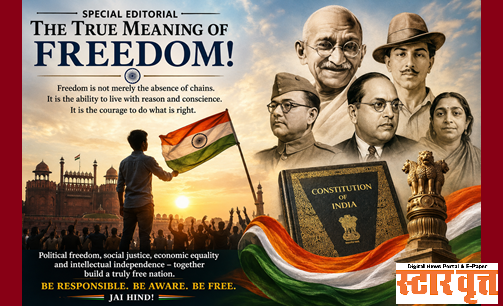
Special Editorial… The True Meaning of Freedom!
India did not simply become independent; the freedom fighters and revolutionaries fought relentlessly and won freedom for the nation. Their struggle was driven by a sacred and powerful conviction:
“India is our country. We shall govern our own country. We have the strength to take our nation forward. The people of India are neither servants nor subjects to be exploited; they are sovereign. The people themselves have the ability to work for the welfare of the nation. The people of this country shall never be slaves to anyone; rather, as the true owners of their nation, they shall discharge their duties with responsibility.”
With this noble spirit, countless freedom fighters and revolutionaries fought for India. They sacrificed their lives, endured unimaginable suffering and dedicated everything they possessed to the nation. The culmination of this long struggle came on 26 January 1950, when India truly became a Republic. The Constitution gave the nation and its people a strong democratic foundation.
To all those who fought for the country and sacrificed their lives for its freedom, a million salutes on this Independence Day!
India has now completed 80 years of independence. During these eight decades, the nation has stood firmly on its own feet. By embracing science, technology and modernity, India has made remarkable progress. From agriculture to space science, from computer technology to artificial intelligence, India’s achievements have earned recognition across the world.
Our nation stands strong today because behind its progress lies a history stretching back thousands of years. The foundations of today’s India were built through the sacrifices of millions of people who dedicated their lives to the nation. Such sacrifice and dedication continuously strengthen a country.
Therefore, every citizen must remain grateful to all those who contributed to the making of this nation. Gratitude must be reflected through responsible citizenship and a strong sense of duty. The feeling of “Nation First” must be nurtured. Only then can we become truly strong along with our nation.
For that, we must understand the true meaning of freedom.
What Exactly Is Freedom?
Without understanding the meaning of “Self”, it is impossible to fully understand the meaning of “Freedom.”
Whenever 15 August arrives, one emotion immediately awakens within us: India became independent! The Tricolour is unfurled, the national anthem fills the atmosphere, we remember the freedom fighters and proudly proclaim, “Bharat Mata Ki Jai!”
But beyond this celebration, do we ever ask ourselves one fundamental question?
What exactly is freedom?
The British left India and the country became independent. This is an undeniable historical fact. But liberation from foreign rule is only one part of freedom. The true meaning of freedom is far broader.
The journey begins with the word “Self.”
To understand freedom, we must first understand self. The “self” represents one’s existence, identity, thoughts and ability to make one’s own decisions.
Self-respect means awareness of one’s own dignity and existence.
Self-reliance means standing on one’s own strength.
Self-determination means having the ability to make one’s own decisions.
Therefore, freedom is not merely the breaking of external chains; it is also the process of breaking the chains of mental dependence.
Who Is a Slave and Who Is Free?
A person who must depend upon someone else’s wishes for every important decision in life is, in essence, dependent.
A person who has the freedom to think, question, decide and determine the direction of his or her own life is truly free.
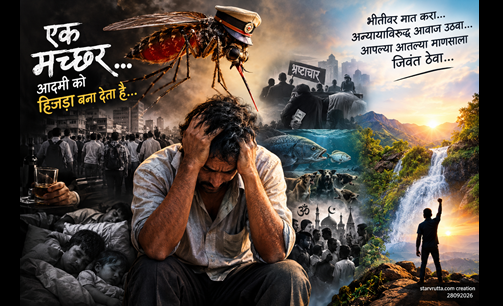
Therefore, even if a country is politically independent, if its citizens live in fear, cannot raise their voices against injustice, or have lost the courage to oppose corruption, then somewhere the spirit of freedom has been weakened.
Freedom Does Not Mean “I Can Do Whatever I Want”
In today’s world, the meaning of freedom is often misunderstood.
“I am free. I will do whatever I want!”
But this is not the true meaning of freedom.
The boundary of my freedom begins where another person’s freedom must be respected.
I have the right to speak, but not the right to defame another person.
I have the freedom to think, but not the right to prevent someone else from thinking.
I have the right to protest, but not the right to destroy public property.
I have the freedom to practise my religion, but not the right to insult another person’s faith.
Freedom, therefore, must always be accompanied by reason, responsibility and respect for others.
Political Freedom Has Been Achieved; What About Social Freedom?
This is an important question.
India achieved political independence in 1947. But when we consider the vision of social justice articulated by Dr. B. R. Ambedkar, the meaning of freedom becomes much broader.
If a person is discriminated against because of birth, if women do not receive equal opportunities, if it is difficult for a poor person to obtain justice, or if a citizen is intimidated because of his or her opinions or beliefs, then we must ask:
How complete is freedom from that person’s perspective?
This discussion is essential.
Political freedom must be accompanied by social, economic and intellectual freedom.
The Mind Must Also Be Free
A nation cannot be truly free merely because its borders are independent. The minds of its citizens must also be free.
Mental slavery is among the most dangerous forms of slavery.
Foreign domination is visible and can be fought. But mental slavery is invisible.
Slavery to superstition.
Slavery to ignorance.
Slavery to rumours.
Slavery to caste prejudices.
Slavery to personality cults.
Slavery to the mentality of compromising with corruption.
These are all invisible chains.
In the age of social media, this problem has become even more serious.
Instead of thinking for ourselves, we often believe a social media post.
Instead of verifying facts, we forward them.
Instead of examining an argument, we accept it simply because a particular person has said it.
Having the freedom to think but choosing not to think is itself a form of mental slavery.
The Right to Question Is the Soul of Freedom
Every citizen must have the freedom to ask questions—and, more importantly, must possess the courage and ability to do so.
A truly free citizen questions the government, the administration, the system and, when necessary, even himself or herself.
A citizen who asks questions strengthens democracy. A citizen who accepts everything blindly weakens it.
Therefore, journalism, literature, art, the judiciary, educational institutions and independent-minded citizens are among the important pillars that protect freedom in a democracy.
What Did the Freedom Fighters Actually Fight For?
We must remember every day—not merely on Independence Day or Republic Day—what our freedom fighters gave to the nation.
They did not fight merely to transfer political power from the British to Indians.
They dreamed of an India in which the ordinary citizen could live with dignity and self-respect.
Mahatma Gandhi’s concept of Swaraj was not limited to Indians taking control of political power in Delhi. It encompassed self-governance, self-discipline, Gram Swaraj and moral responsibility.
Bhagat Singh’s struggle was not merely against British rule; it was also against exploitation and injustice.
Dr. B. R. Ambedkar emphasized that political democracy must be accompanied by social democracy.
Therefore, today we must ask ourselves a difficult but necessary question:
Are we truly living as free citizens in the India for which our freedom fighters sacrificed their lives?
Who Is Responsible for Protecting Freedom?
Winning freedom is difficult.
Protecting freedom is even more difficult.
Our soldiers protect the nation’s borders.
The Constitution provides the framework for protecting democracy.
The judiciary safeguards citizens’ rights.
The media questions those in power.
And ultimately, it is the aware and responsible citizen who protects democracy.
Therefore, Independence Day is not merely a day for flag hoisting.
It is a day for self-introspection.
Are we truly free?
Do we ask questions without fear?
Do we respect the freedom of others?
Do we refuse to remain silent when we witness injustice?
Do we oppose corruption?
Do we search for truth instead of blindly believing rumours?
The answers to these questions reveal how deeply we understand the meaning of freedom.
Freedom Begins With the “Self”
The true beginning of freedom is within ourselves.
It is easy to believe that the nation’s freedom began in Delhi. But a citizen’s real freedom begins within the individual.
Think independently.
Make your own decisions.
Take responsibility for those decisions.
Stand against injustice.
Respect the rights of others.
Have the courage to stand on the side of truth.
Because freedom is not merely the absence of chains.
Freedom is the ability to live with reason and conscience.
Freedom is not the licence to do whatever we want.
Freedom is the courage to do what is right.
Freedom is not merely liberation from foreign rule.
It is a continuous journey towards freedom from ignorance, fear, injustice and mental slavery.
The Tricolour and Our Responsibility
On 15 August, as the Tricolour flies proudly in the sky, we look at it with immense pride.
But the Tricolour will receive its true homage only when every citizen of this country can live with self-respect, fearlessness, responsibility and equality.
Because the independence of a nation is a historical event;
but remaining free as citizens is a responsibility we must fulfil every single day.
Heartfelt greetings to everyone on Independence Day!
Jai Hind!
— Narendra Hadkar